Complete Loop
Part 5 · A Complete Loop, Twice
The capstone of the build track: every organ from Parts 1–4 wired together into one production loop — and then wired together again in a second tool,…
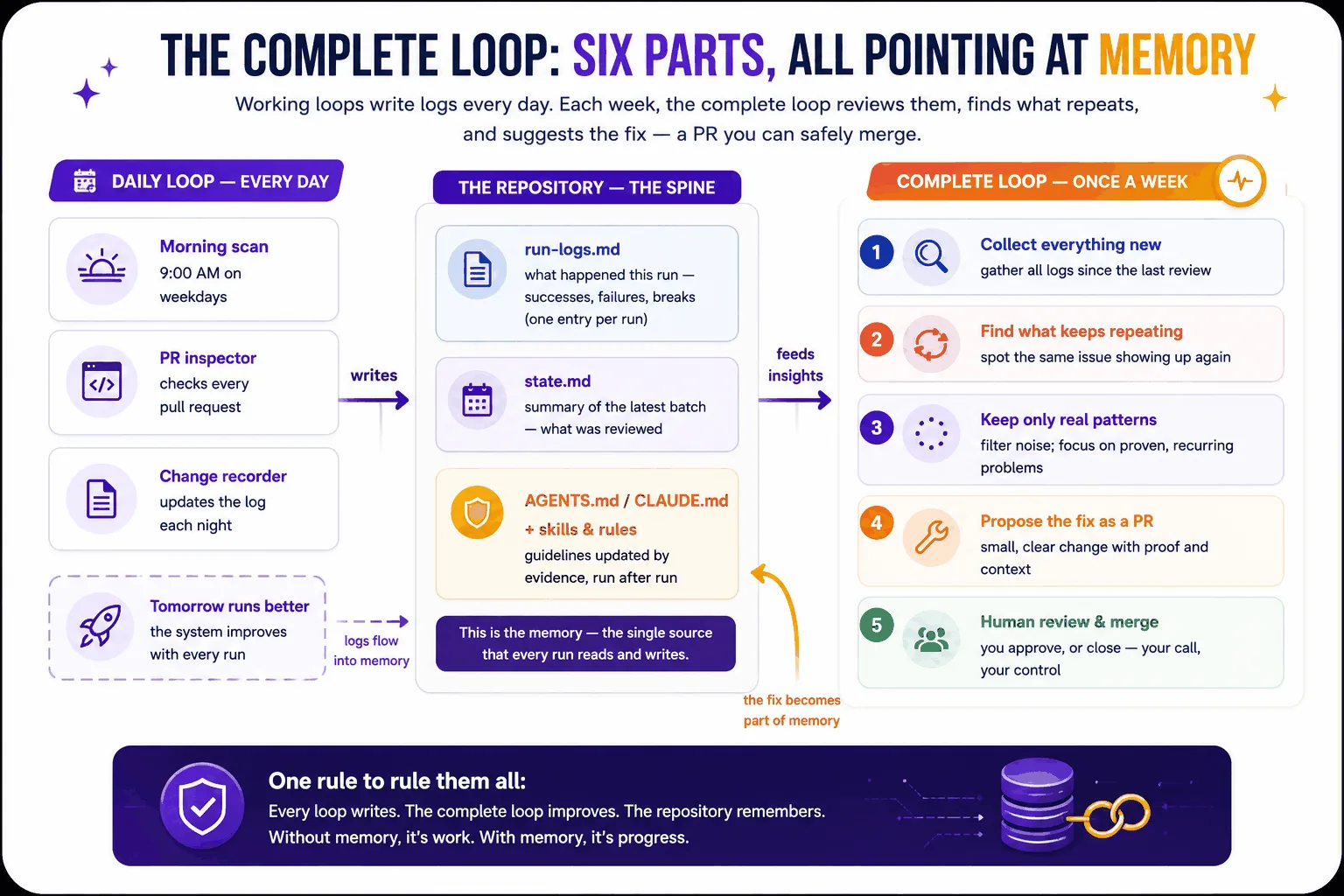
The capstone of the build track: every organ from Parts 1–4 wired together into one production loop — and then wired together again in a second tool, so you can finally see where the shape ends and the plumbing begins.
The steps
| Step | Page | One-line takeaway |
|---|---|---|
| 13 | Build the Morning-Triage Loop | the design: six parts filled in + the 7-item minimum-safe checklist |
| 13a | Claude Code walkthrough | skill · reviewer agent · Routine/cron · permissions · one real morning |
| 13b | OpenCode walkthrough | same skill, same rubric — cron + wrapper script as visible lumber |

Why build it twice?
Because the second build is what finally lets you answer the one portability question that actually counts: if you switched tools tomorrow, what would carry over? (Every one of the six organs, the checklist, the L1 discipline.) And what wouldn't? (Every command you typed.) Commit the first list to memory; look the second one up when you need it. That's the lasting-vs-mechanical rule this course keeps hammering on — and here you get to watch it play out live.
Check your understanding
Take the Part 5 quiz — (this part has no flashcards on purpose: the exercise IS the two builds).
Then onward to the final part: Part 6 · Human Control.
This part belongs to track T3 · Engineer.
Sources: Part 5 draws on Panaversity's Loop Engineering: A Crash Course (S1). Full attribution: resources/sources.md.