Heartbeat
Part 2 · The Heartbeat
Four ways a loop decides when to beat — from a timer you can watch tick, to the world itself reaching over and pulling the trigger. Read this part as a…
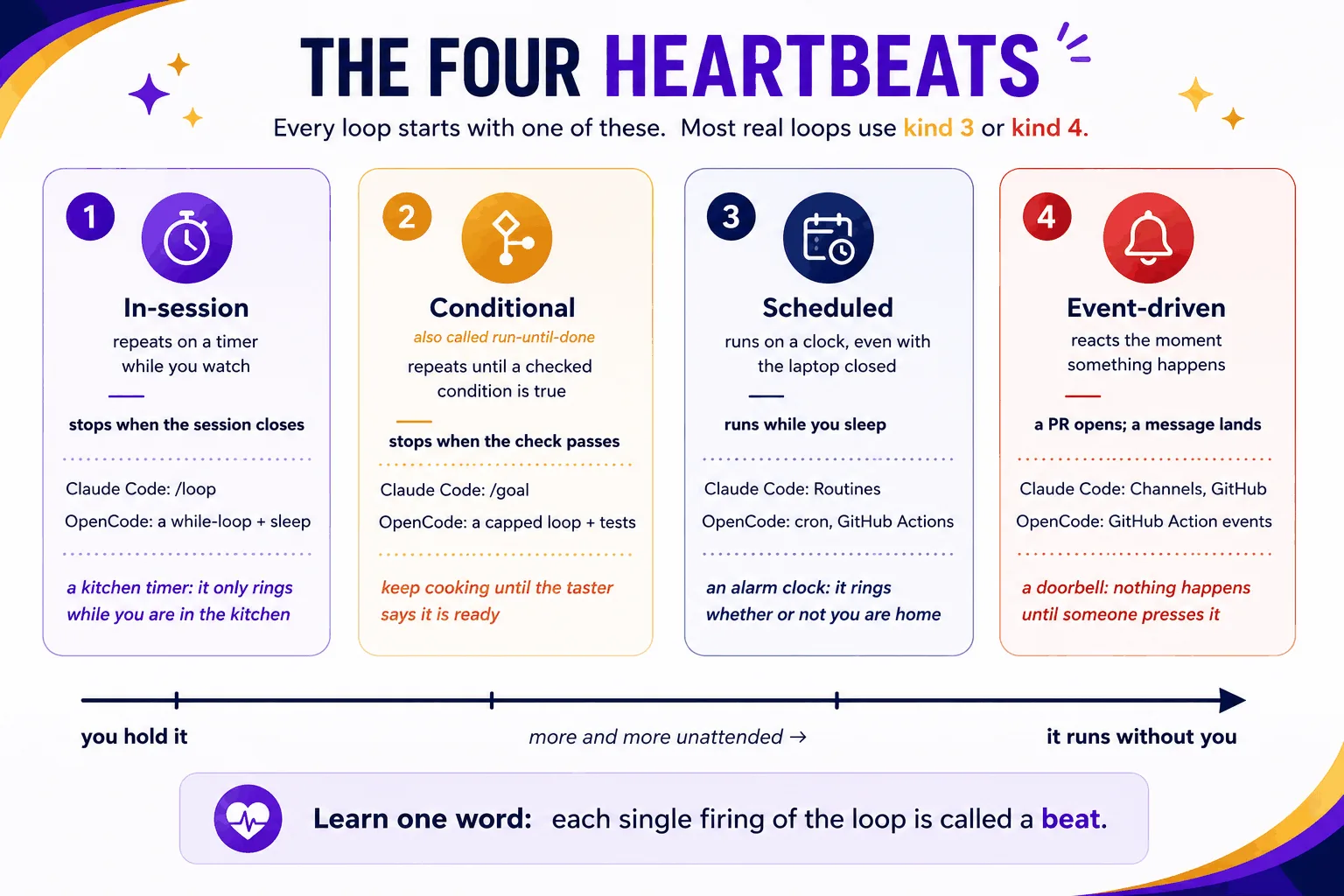
Four ways a loop decides when to beat — from a timer you can watch tick, to the world itself reaching over and pulling the trigger. Read this part as a menu, not a ladder: real fleets mix all four.
The steps
| Step | Page | Heartbeat | One-line takeaway |
|---|---|---|---|
| 04 | In-Session Loops | interval, inside a session | training wheels: watchable, interruptible, dies with the session |
| 05 | Conditional — Run Until Done | the goal itself | everything hangs on three stops: success, limit, no-progress |
| 06 | Unattended Schedules | cron, nobody watching | four parts (prompt·repos·connectors·trigger); guardrails first |
| 07 | Event-Driven | the world | dropped-not-queued; always pair with a reconciliation sweep |

The thread through all four
Two rules keep coming back on every page, because they hold for every heartbeat there is:
- Missed beats are dropped, not queued — so design beats that act on now, not on a backlog of moments that have already passed.
- The heartbeat only decides when. What a beat may touch (body), what it remembers (spine), and when it all ends (stops) are the other four organs — Part 3 picks up the body.
Check your understanding
Take the Part 2 quiz · drill the flashcards
This part belongs to track T2 · Practitioner.
Sources: Part 2 draws on Panaversity's Loop Engineering: A Crash Course
(S1),
Spec-Driven Development
(S3),
Scheduled Tasks: The Loop Skill & Cron Tools
(S4), and the
cobusgreyling/loop-engineering reference repo
(S7, MIT). Full attribution:
resources/sources.md.