The Shift
Part 1 · The Shift
From prompting to looping: what actually changes, which layer you're standing in, and the six-part anatomy every loop shares. This part is pure mental…
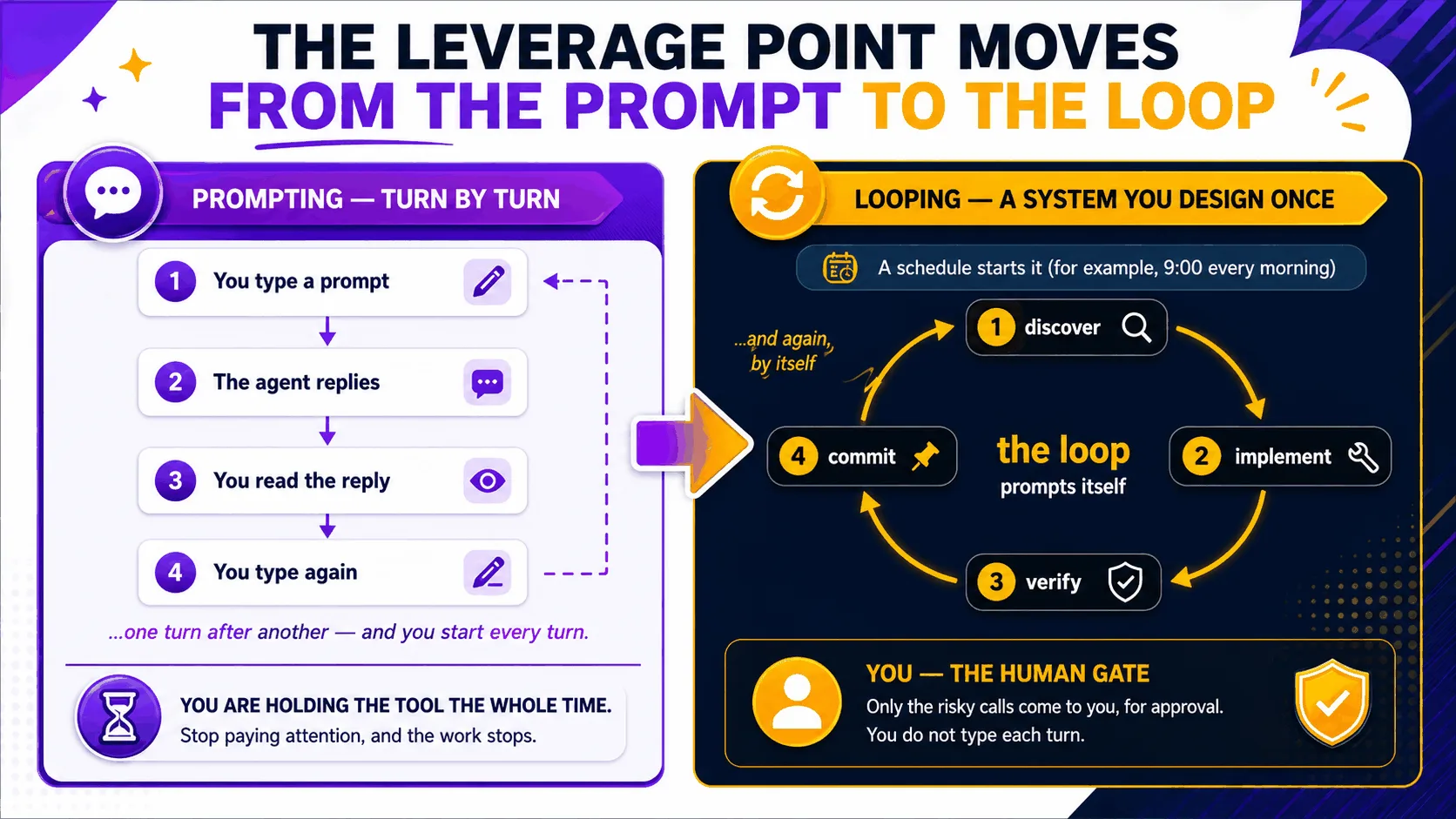
From prompting to looping: what actually changes, which layer you're standing in, and the six-part anatomy every loop shares. This part is pure mental model — the machinery gets switched on in Part 2.
The steps
| Step | Page | One-line takeaway |
|---|---|---|
| 01 | From Prompting to Looping | Move the management, keep the intent and the accountability |
| 02 | The Four Layers | Prompt → context → harness → loop; fix problems at the right layer |
| 03 | Anatomy of a Loop | Six parts, every loop: heartbeat, body, spine, stop, checker, gate |

Before you start
Comfortable driving an AI coding agent by hand? If not, take the short detour through the agentic coding primer first — this part assumes it. And keep the glossary open in a tab; the bold terms below all live there.
Check your understanding
Once the three steps are behind you: take the Part 1 quiz · drill the flashcards.
This part belongs to track T1 · Foundations.
Sources: Part 1 draws on Panaversity's Loop Engineering: A Crash Course (S1), Addy Osmani's Loop Engineering (S5), Sydney Runkle's The Art of Loop Engineering (S6), and Peter Steinberger & Boris Cherny's public statements (S8). Full attribution: resources/sources.md.