The Body
Part 3 · The Body
What a beat may do and touch — and how to keep many hands from colliding: isolation, taught moves, hands on the world, and the split that keeps work…
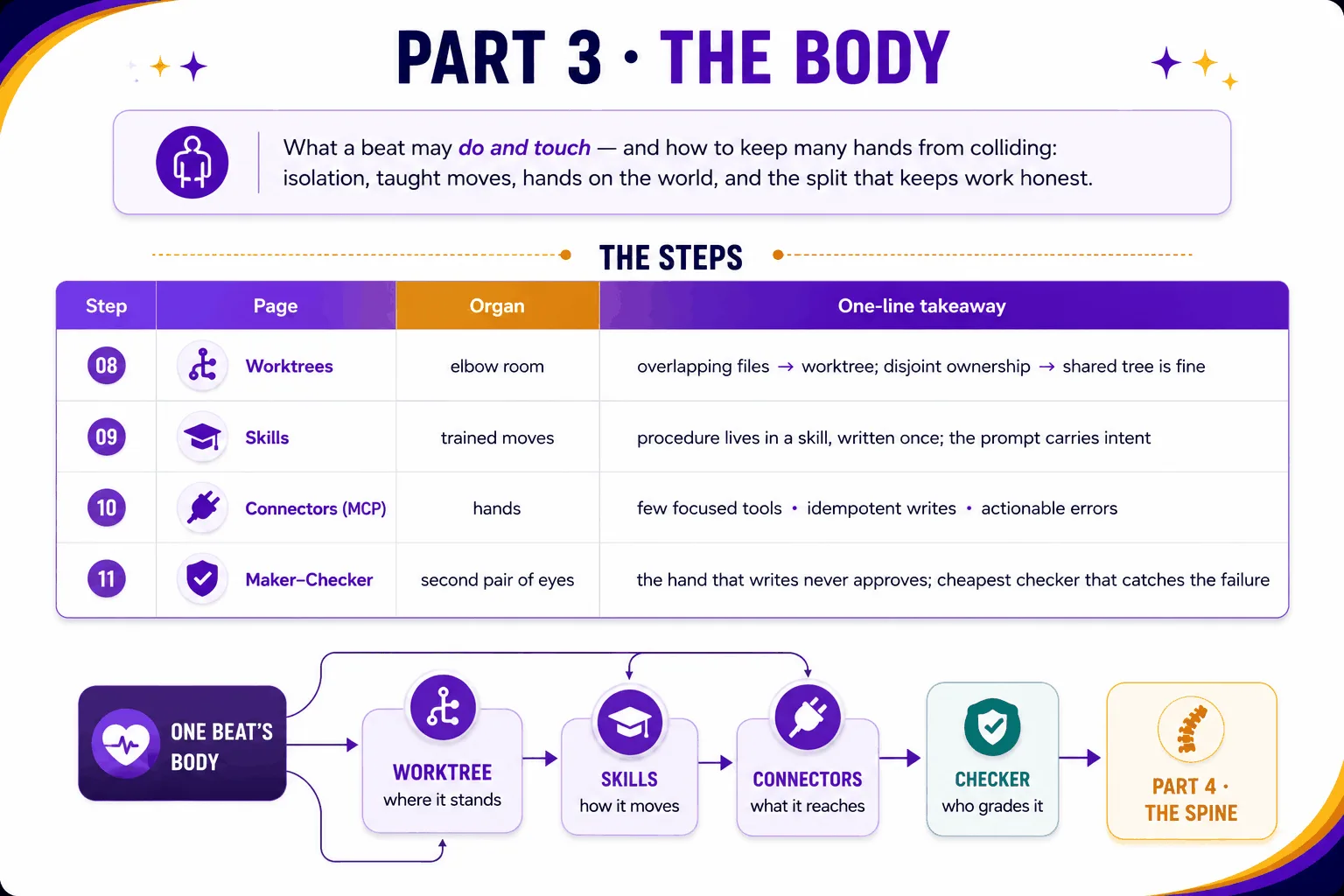
What a beat may do and touch — and how to keep many hands from colliding: isolation, taught moves, hands on the world, and the split that keeps work honest.
The steps
| Step | Page | Organ | One-line takeaway |
|---|---|---|---|
| 08 | Worktrees | elbow room | overlapping files → worktree; disjoint ownership → shared tree is fine |
| 09 | Skills | trained moves | procedure lives in a skill, written once; the prompt carries intent |
| 10 | Connectors (MCP) | hands | few focused tools · idempotent writes · actionable errors |
| 11 | Maker–Checker | second pair of eyes | the hand that writes never approves; cheapest checker that catches the failure |

The thread through all four
The body is where blast radius gets decided — and every page in this part is really the same rule wearing a different hat. Give a beat exactly the standing room, the moves, and the reach its job needs, and not one inch more. Put the grading outside the hands that did the work. What the body remembers between beats is Part 4's problem, not this one's.
Check your understanding
Take the Part 3 quiz · drill the flashcards
This part belongs to track T2 · Practitioner.
Sources: Part 3 draws on Panaversity's Loop Engineering: A Crash Course (S1), Agentic Coding Crash Course (S2), and Sydney Runkle's The Art of Loop Engineering (S6). Full attribution: resources/sources.md.